
Micron develops edge inference memory for physical AI applications
Micron is advancing the development of a specialized storage chip for physical AI applications called Edge Inference Memory (EIM). At a semiconductor forum in Seoul during SEDEX 2026, Micron executive Lee Jeok emphasized the rapid growth of markets such as autonomous driving, humanoid robots, and AR/VR, and noted the company's collaboration with key clients to develop products tailored for these areas. EIM is designed to process AI inference data quickly by stacking low-power memory on top of logic chips, differing from in-memory computing (PIM) in architecture but sharing the goal of improving data efficiency. Micron has not yet disclosed performance metrics for EIM, but is working on integrating it with LPDDR6. Industry experts predict mass production by late 2028. Humanoid robots, which require real-time environmental sensing and decision-making, demand higher memory bandwidth than traditional industrial robots. Currently, they rely on LPDDR memory, but as AI models grow in complexity, Micron forecasts a shift to high-bandwidth memory (HBM). Lee Jeok noted that while current models use 1B–2B parameters, future visual language models will necessitate HBM. Micron also anticipates a need for 200GB DRAM and 4TB storage in advanced humanoid robots, compared to 12GB DRAM and 256GB storage in current models. The company is collaborating with robot manufacturers, chip designers, and cloud providers to shape early system designs for physical AI.
OpenAI advances in humanoid robotics with focus on AI 'brain'
OpenAI, led by CEO Sam Altman, is advancing its humanoid robot project, emphasizing the development of an AI 'brain' over physical design. Altman stated that humanoid form is logical since the world is designed for humans, with tools and environments shaped around human anatomy. He noted that the priority is creating a 'brain' that enables the robot to use its limbs effectively, rather than focusing on aesthetics. OpenAI plans to unveil a prototype in 2027 but expects full deployment to take years. The project involves complex tasks like object manipulation and environmental adaptation, requiring advanced machine learning and robotics expertise. OpenAI is hiring across multiple domains, including motion control and hardware development, and has already made progress with projects like Dactyl, which trained robotic hands in simulated environments. While competitors like Tesla and Xiaopeng have developed humanoid robots, OpenAI’s focus remains on AI integration and practical applications, such as infrastructure support and personal assistance, with no consumer pricing or release date announced yet.
Lenovo unveils ai-powered p7 host with custom chip combo
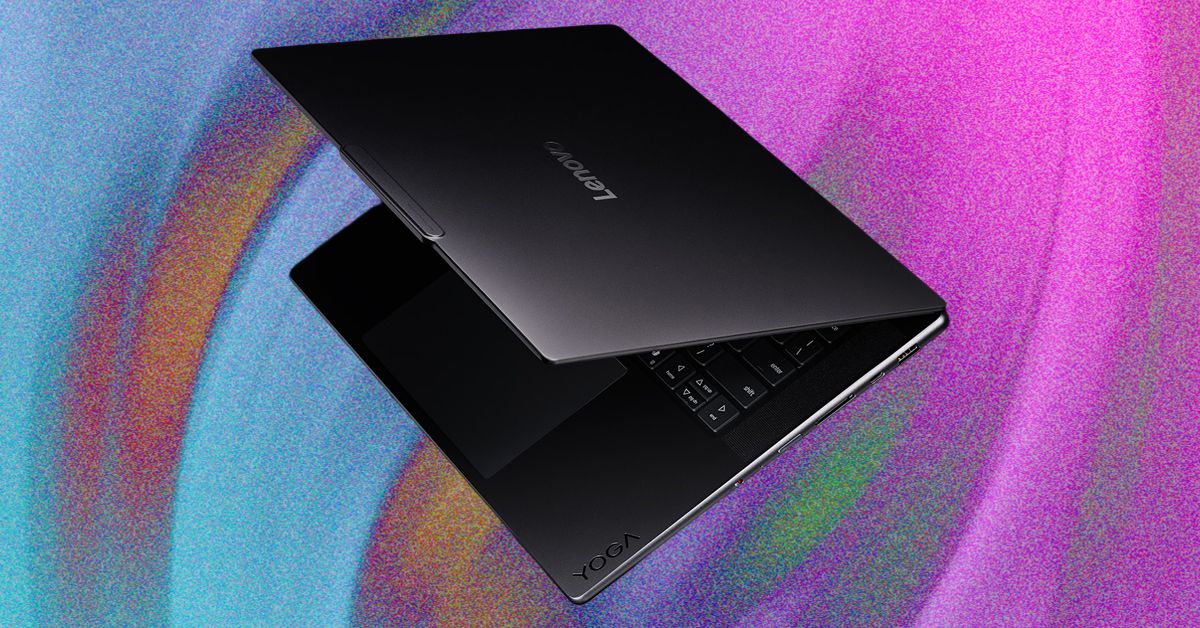
Lenovo announced on October 18 that it will launch the AI Host P7 on October 24, during a special event in Changsha, China. The device will be available for pre-order on the same day. The P7 is powered by a custom chip combination from Zhixin Technology and Houmo Intelligence, featuring the P1 SoC and M50 dNPU. This setup provides 190TOPS of local AI computing power, enabling the deployment of 122B LLM models with a context window of 128K and a local inference rate of 50TPS. The launch follows an announcement made in May, where Lenovo detailed the technical specifications of the P7. The AI Host P7 is positioned as a high-performance device for developers and AI enthusiasts, leveraging the latest advancements in AI chip technology.
Kyutai unveils REKI: a 2.4B vla model enhancing robot manipulation with efficient memory
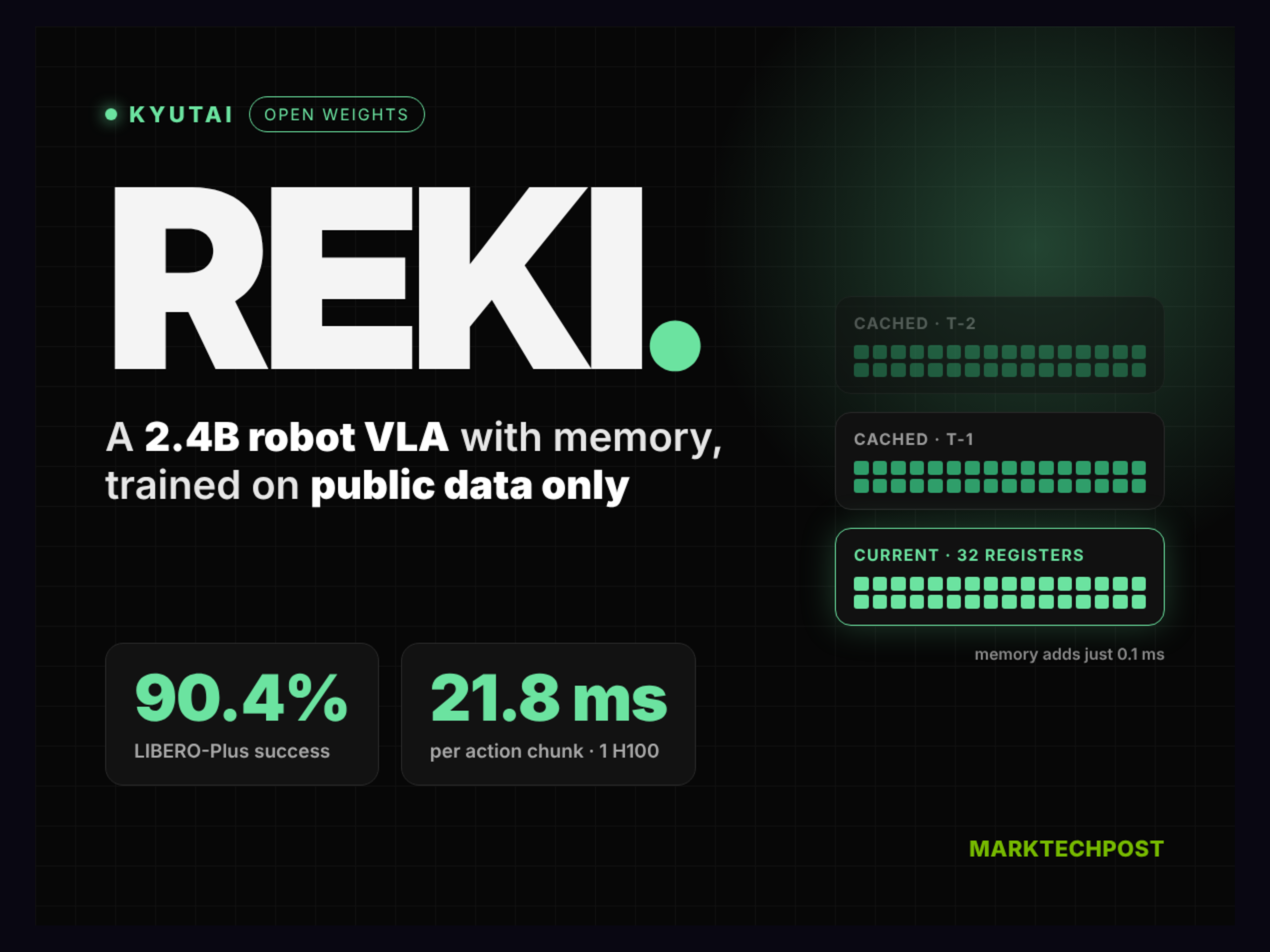
Kyutai, in collaboration with Inria and École des Ponts, has introduced REKI, a 2.4B vision-language-action (VLA) model designed to improve robot manipulation. REKI is pretrained on public data and features a low-cost memory system that retains recent past information. It outperforms models of similar size on three out-of-distribution benchmarks, with only larger models surpassing it. All model weights are now available on Hugging Face. REKI integrates a Qwen3.5-2B backbone with a 200M-parameter action expert, generating action chunks through flow matching across 10 Euler steps. The model uses adaptive RMSNorm for robot state and flow time, with each state layout having its own small state MLP. Unlike most VLAs that rely solely on the current frame, REKI embeds memory within the action expert, using 32 learned register tokens that cross-attend encoded prompts and views while self-attending earlier frames. This design reduces oscillation in robotic arms, cutting failure rates on RoboTwin from 18.6% to 4.1%. Pretraining significantly boosts performance, adding 13.8 points on Clean2Rand and 30.3 under clutter. Memory further improves results, adding 1.5 points on LIBERO-Plus and 5.4 on RoboCasa365. The model is pretrained once and fine-tuned per benchmark, with six checkpoints available, including versions for LIBERO, RoboTwin, RoboCasa365, and RoboCasa-GR1. REKI is optimized for real-robot deployment using the LeRobot protocol, with fine-tuning on a UR5 arm requiring 3,000 steps over one hour.

Anthropic removes haiku 4.5 from public models
Anthropic announced on October 15, 2026, that Haiku 4.5 will be removed from its Free, Pro, and Max plans starting October 29, 2026. The change affects all platforms, including web, desktop, and mobile, as well as features like Claude Cowork and Claude Design. Users can still access Haiku 4.5 through the 'More models' section until October 29, after which it will no longer appear in the model selector. If users are currently using Haiku 4.5, the system will automatically switch them to Haiku 5.5. The update does not impact Haiku 4.5’s availability in Claude Code, Team, Enterprise plans, or via the Anthropic API. Existing Haiku 4.5 conversations will remain intact, and users can continue interacting with them using Haiku 5.5 after October 29. They can also export their chat data if needed. Haiku 5.5, launched on October 7, 2026, is the first model in the series to allow adjustable thinking levels, with a context window of 1 million tokens and a maximum output of 128K tokens. It shows significant improvements in coding and agent tasks compared to Haiku 4.5. Anthropic noted that the average cost of running Haiku 5.5 is about 75% lower than Haiku 4.5, with a 90% cost reduction for prompts under 100,000 tokens, which covers approximately 90% of all requests in the series.
China launches first fully autonomous weather AI forecasting system
China has deployed its first fully autonomous weather AI forecasting system, 'Fengqing,' which is now operational across the country. Developed by the National Meteorological Center in collaboration with multiple universities and research institutes, the system leverages the National Supercomputing Center in Tianjin's AI4S supercomputing cluster. It is the first system in China to achieve full control over data, models, and computing power, marking a significant advancement in meteorological AI technology. Fengqing uses a visual Transformer architecture combined with meteorological physics constraints to improve the accuracy of forecasts for extreme weather events such as typhoons and heavy rainfall. The system can predict weather conditions up to 11 days in advance, outperforming the latest AI-based forecasting systems from the European Centre for Medium-Range Weather Forecasts (ECMWF) in several key metrics. It also enables rapid global weather simulations, enhancing the ability to predict long-term weather trends and extreme events. The system will support various sectors including disaster prevention, transportation, energy management, and public services. Tianjin's continued investment in supercomputing and AI has enabled this breakthrough, which is expected to strengthen China's capabilities in meteorological innovation and global weather forecasting.

DeepSeek releases V4.1-Flash-1017 with enhanced performance and reduced costs
On October 17, 2026, DeepSeek announced the release of its V4.1-Flash-1017 version, updating its official website, app, and API models. The new version achieves a Pareto improvement in performance and cost efficiency, with improved model capabilities and reduced task execution time and output length, leading to lower overall costs per call. DeepSeek highlighted that the new model enables users to complete tasks more efficiently and at a lower cost, reaching new Pareto optimal points in performance and cost across multiple platforms. The update also includes optimizations for DeepSeek Harness, Tencent CodeBuddy, and WorkBuddy, with recommendations for users to upgrade to version 0.2.1-rc.1 or higher to fully benefit from the improvements. Additionally, the V4.1-Flash-1017 version introduces enhanced zero-shot project-building capabilities through self-feedback reinforcement learning, supporting scenarios like game development and 3D modeling. DeepSeek claims this allows the model to fulfill 'wish-based' programming requests, generating executable projects with minimal input. The model weights are now available for download on HuggingFace and ModelScope, continuing the MIT license open-source strategy.
China launches first deterministic network-based agent interconnection platform
On October 16, 2026, the tenth Future Network Development Conference in Nanjing marked the official launch of AXP, the first industry platform based on deterministic networks for agent interconnection. Developed by the Purple Mountain Lab in collaboration with China Mobile, Jiangsu Future Network Group, and Jiangsu Future Network Innovation Research Institute, AXP supports up to a million agent registrations and 100,000 agents running simultaneously. The platform enables seamless integration of intelligent computing networks, protocol conversion, and rapid fault detection with sub-second response times. AXP, leveraging the National Future Network Test Facility (CENI), allows precise cross-domain agent access over 4,000 kilometers, reducing end-to-end task execution time by over 20%. The platform is currently undergoing multi-scenario testing with telecom operators, equipment providers, and large steel manufacturers. This milestone signifies a key technological breakthrough in China's intelligent agent internet infrastructure, offering robust network support for cross-domain AI collaboration and large-scale deployment.
Microsoft and carnegie mellon launch PRAISE to guide junior programmers in AI era
Microsoft and Carnegie Mellon University have launched the PRAISE initiative, a mentorship program designed to guide junior programmers in an era where AI can rapidly generate code and participate in system design. The project, inspired by clinical mentorship in healthcare, pairs early-career engineers with senior mentors to foster system thinking, judgment, and responsibility. The initiative emphasizes that AI changes the nature of work, not the responsibility for software quality and safety. Microsoft argues that engineers must still understand the underlying logic of code to diagnose and fix system failures. Carnegie Mellon will provide formal courses and group discussions to connect computer science theory with real-world software development. Michael Hilton, a university teacher, noted that the traditional model of skill-building through repetitive tasks is no longer sufficient, and a new approach is needed to prepare junior engineers for the AI-driven future. The PRAISE program aims to ensure that junior programmers develop critical skills such as engineering judgment and responsibility, rather than simply mimicking AI behavior. It seeks to balance the integration of AI tools with the need for human oversight and expertise. By combining academic rigor with industry practice, the initiative hopes to create a sustainable path for the next generation of software engineers in an increasingly automated field.
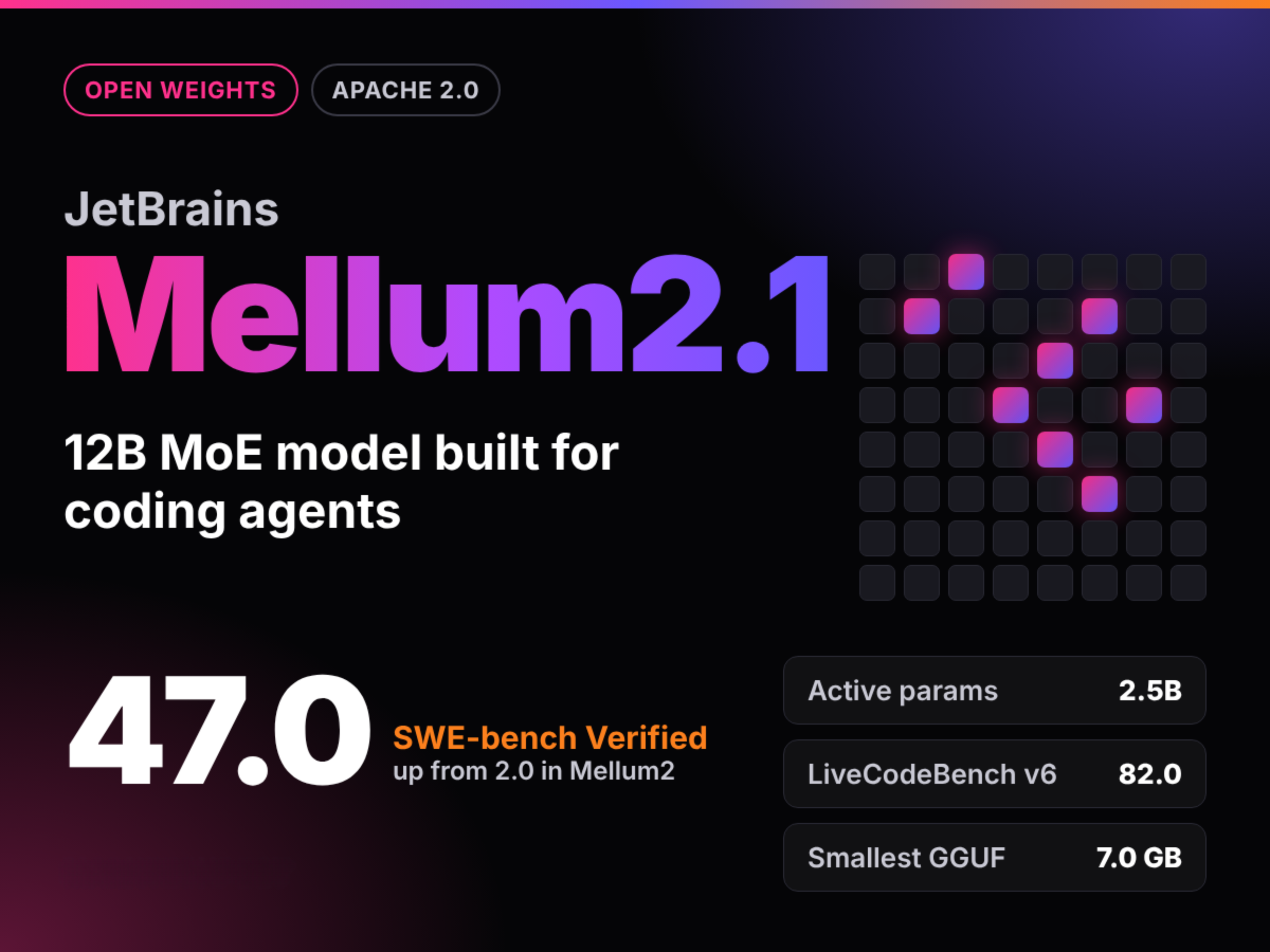
JetBrains launches junie local with nvidia rtx spark support, achieving 55 tokens per second
JetBrains has announced that its local AI programming tool, Junie Local, is now Day 0 compatible with NVIDIA's RTX Spark platform. The update also marks the transition of Windows support from experimental to stable. Users can now run the tool on compatible hardware, allowing AI to read, modify, and execute code without needing to upload data to the cloud. The tool is free to use, with no registration, subscription, or token costs. In performance tests, Junie Local achieved a maximum throughput of 55 tokens per second on the RTX Spark platform. The hardware requirements have been expanded to include RTX 3090, 4090, and 5090 GPUs with at least 24GB of VRAM, alongside Windows 11 and updated NVIDIA drivers. The new version of Junie Local automatically checks for compatible GPUs and drivers, deploys models, and adjusts context capacity based on available GPU memory. Users can choose between Qwen3.6-27B or a model provided by JetBrains. The tool is designed to retain more code and conversation history, enhancing the AI's ability to assist with complex programming tasks.
Elon musk's Hagglebot aims to boost corporate cost efficiency by over 5%
Elon Musk, the world's richest person, announced on October 17, 2026, via X, that his team is developing a specialized AI negotiation tool called Hagglebot for business use. The AI software, designed to help companies secure better deals, is positioned as a 'digital procurement negotiator' that can assist in price negotiations based on user-defined budgets and acceptable terms. Musk estimates that the tool could increase corporate cost efficiency by 5% or more, potentially saving up to $6 trillion annually globally if applied to the entire GDP scale. The announcement followed a user's post highlighting that Hagglebot had already saved over $100,000 for a team in its first week of operation. While the tool is focused on commercial negotiation rather than general chat functions, details about its negotiation strategies, supported transactions, launch timeline, pricing, and availability remain undisclosed.
Intel announces plans for 'razor lake ax' processor for physical AI in 2028
Intel's senior vice president, Jo Min-sung, announced at the 'Semiconductor-Driven Humanoid Robots' conference in South Korea that the company plans to launch the 'Nova Lake' processor for the physical AI sector in early 2027. Following this, Intel intends to release the 'Razor Lake AX' in 2028, which will offer a platform with a total computing power of 700 TOPS, significantly surpassing the 180 TOPS of the 'Panther Lake'. The 'Razor Lake AX' is set to be Intel's first commercialized large-memory bandwidth big-core GPU SoC. It will utilize the standard 'Nova Lake' core architecture while integrating 16 or 32 Xe3P cores, enhancing both graphical display and AI inference capabilities. This marks a significant step forward in Intel's strategy for physical AI applications.

OpenAI addresses model capacity limits with system enhancements and increased computing power
On October 16, 2026, IT Home reported that OpenAI's Codex/ChatGPT lead, @thsottiaux, announced on X that the team had deployed a series of updates and added more computing power to address the 'model capacity limit' error. The changes were part of OpenAI's 28-day continuous delivery plan, with the 11th update announcement highlighting the improvements and increased resources aimed at reducing the frequency of the error. Users have reported that the issue is not always due to the model being fully utilized. Some users with sufficient subscription limits and model switches still encountered the error repeatedly, while developers suspect it may be related to backend requests, session states, or resource scheduling. OpenAI's team has optimized the system and increased computing power to reduce the occurrence of the error. If the error persists, tasks should now automatically continue rather than being stuck in an error state. The team also invited users still experiencing the issue to provide feedback for further investigation.
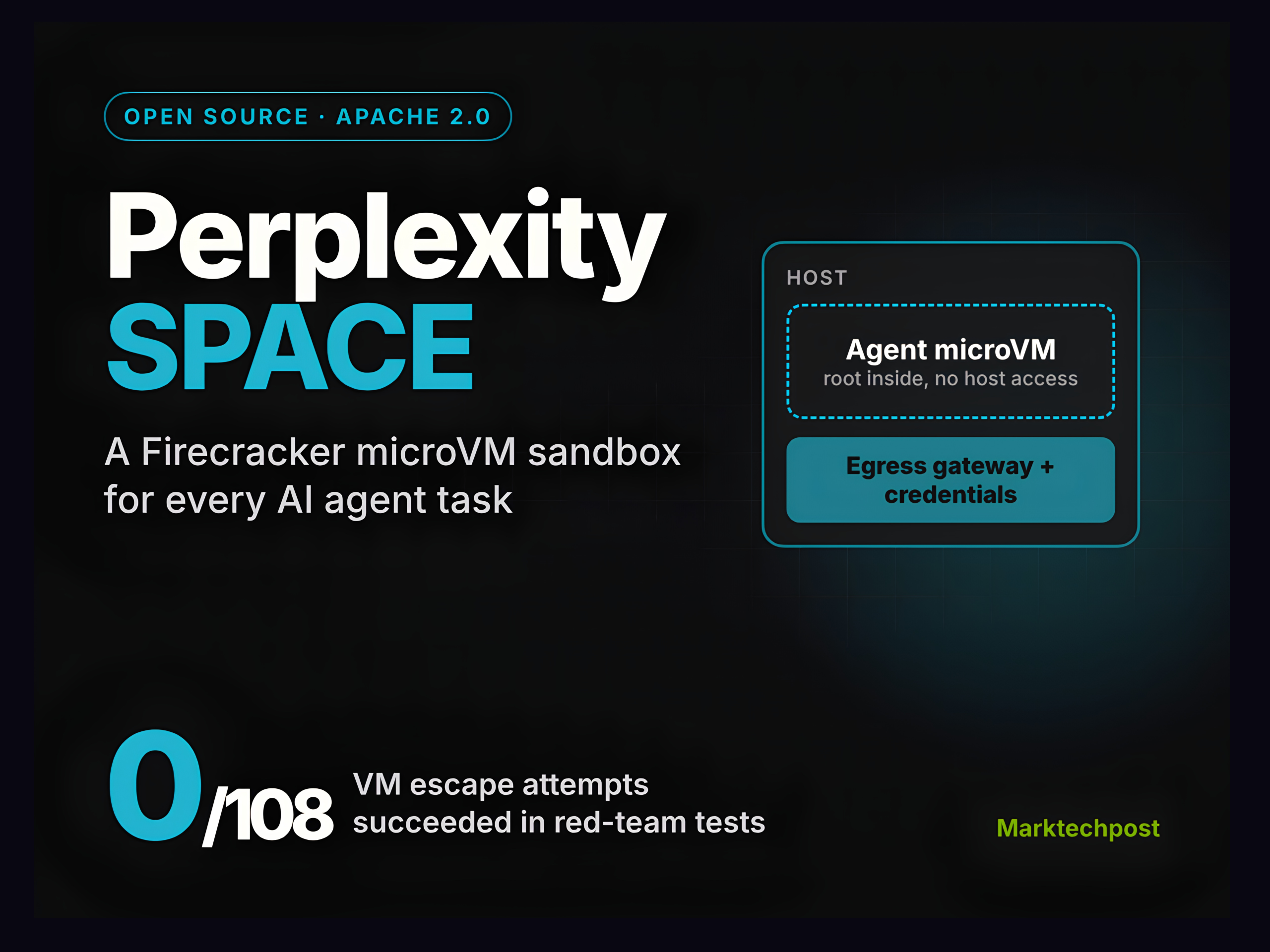
Perplexity launches open-source sandbox for AI agent security
Perplexity has released SPACE, an open-source sandbox platform designed to securely run AI agent tasks in isolated microVMs. The platform, available under Apache 2.0 on GitHub, provides a production-tested isolation layer for teams developing coding or browsing agents. SPACE uses Firecracker microVMs, with each sandbox having its own guest kernel and network gateway to enforce egress policies. Secrets are kept outside the guest, with credentials injected at the network layer, offering hierarchical scoping, rate limits, and audit logging. The system is divided into four components: a PostgreSQL-backed API, controllers, worker services, and a data plane. Worker services manage VMs, networking, volumes, templates, and credentials, with btrfs copy-on-write creating root filesystems. Sandboxes can be in four states: running, paused, suspended, or deleted. Kubernetes deployments use warm pools for fast creation, while single-node setups use base snapshots. Perplexity reported that 100% of Computer sessions run on SPACE, with latency reduced to 89 ms from 447 ms. A security report tested nine models, finding bypasses in four, including Claude Opus 5.0 and GPT-5.6 Sol. Perplex, the company, added source-address validation through nftables, and subsequent tests showed no verified bypasses. The team also tested ten third-party platforms, with eight showing network-policy bypasses, and disclosed results to affected vendors.
Itaú expands generative AI to serve entire customer base by year-end
Itaú, Brazil’s largest bank, is leveraging generative AI to enhance customer and employee experiences through its AI First strategy. The bank’s ia.i platform, a conversational interface, aims to serve its entire customer base by the end of 2026. Carlos Eduardo Mazzei, Itaú’s CTO, emphasized the importance of simplicity and directness in AI solutions, stating that the technology should be almost unnoticeable to customers. A study by Itaú and Grupo Consumoteca revealed that 80% of Brazilians seek better financial organization, with 65% interested in financial copilots. The bank’s AI strategy includes the IARA governance platform, which manages access to various models, ensuring responsible AI practices. IARA supports solutions like the legal department’s automated document analysis, processing over 2 million tasks monthly with efficiency gains of 20% to 80%. Mazzei highlighted the need for secure, governed model usage to maintain economic viability. The platform also powers Customer DNA, enriching financial context for 70 million customers using GPT models. Itaú plans to expand ia.i’s capabilities, including product simulations and recurring financial analyses, by year-end. The bank expects to triple customer relationship time, double service speed, and triple conversation effectiveness. Mazzei stressed that AI should align with the bank’s values, reducing bias and ensuring cultural relevance in customer interactions.

Elorian launches AI model that interacts with visual data directly
Elorian, a Palo Alto-based AI startup, has launched its first model, Glimpse, which allows for direct interaction with visual data. The model, released as a research preview, offers API access and a chat interface, currently available only through a waitlist. Glimpse enables the AI to revisit the source material during reasoning, allowing it to crop images, extract video frames, or run code for analysis, a feature the company calls a 'visual scratch space.' Elorian CEO Andrew Dai, a former Google DeepMind researcher, highlighted the limitations of current AI models in understanding visual cues, citing examples such as board games and IKEA diagrams. He noted that while humans can interpret these visuals with minimal text, AI models struggle to grasp their meaning. Glimpse, however, outperforms models like GPT-6 Astra in scientific chart reasoning and short-form video captioning. The startup, which emerged from stealth six months ago, secured a $55 million seed round at a $300 million valuation. Glimpse costs $0.60 per million tokens in and $3 per million tokens out, positioning it between mid-level and lightweight models. Elorian aims to develop the 'world’s best visual reasoning model' by next year, targeting industries with large video datasets, including robotics and media.
Nvidia's rtx spark n1x powers new laptops, competing with top chipmakers
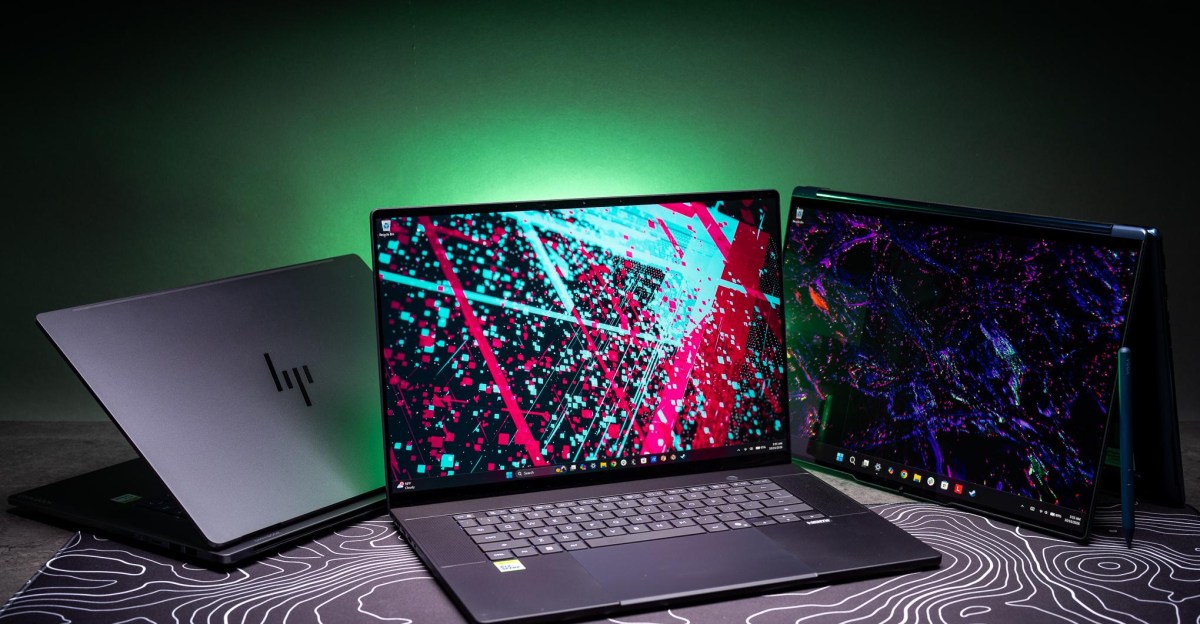
Nvidia has launched its RTX Spark N1X processor, a high-performance Arm-based SoC aimed at laptops and small desktops, competing with offerings from Apple, Intel, AMD, and Qualcomm. The chip features numerous cores, Nvidia RTX Blackwell graphics, and sufficient power and unified memory to run large local AI models. The flagship device is the Microsoft Surface Laptop Ultra, equipped with 128GB of unified memory, reviewed by Tom Warren. Sean Hollister is testing a 64GB version of the Asus model. The Verge provides further details on the performance and capabilities of these new laptops, highlighting Nvidia's advancements in the laptop processor market. The RTX Spark N1X represents a significant step in Nvidia's expansion into the laptop and desktop markets, leveraging its expertise in graphics and AI. With its combination of powerful graphics and unified memory, the processor is positioned to challenge existing leaders in the industry. The Surface Laptop Ultra and Asus variants are among the first devices to showcase the potential of this new technology, offering users enhanced performance and capabilities for running complex AI models locally. The Verge's coverage provides an in-depth look at the performance and features of these devices, underscoring Nvidia's growing influence in the computing space.

AI toys and gadgets set to transform holiday season
The 2026 holiday season is expected to feature a wide range of AI-powered gadgets for both children and adults, with major tech companies unveiling new products. Apple launched the HomeView, a smart home device powered by its AI-enhanced Siri, allowing users to control doorbells, thermostats, and locks. Amazon introduced new Alexa Tablets running on Alexa+, with prices ranging from $229 to $500. Microsoft is set to release the Surface Laptop Ultra, equipped with an Nvidia AI chip, priced at $2,599, beginning shipments on October 16. Meta is expanding its AI offerings with the Muse Charm, a Tamagotchi-like keychain, and a new line of AI-enhanced eyewear, including models without cameras, to address privacy concerns. The company plans to offer 100 different AI glasses by year-end. These developments highlight the growing integration of AI into everyday life during the holiday season. Meta also introduced a Windows version of its Muse AI agent, aiming to leverage its popularity in Apple’s App Store. The company has ambitious plans for its Muse Charm, which can manage tasks like inbox organization and dinner reservations. With AI toys already on the market and a surge in AI-powered devices, the holiday season is shaping up to be a significant milestone in the adoption of AI technology.
Tencent unveils open-source memory framework for AI agents
Tencent has released Hy Memory 2.0, an open-source memory framework for AI agents, along with a dedicated model and MemHub application. The framework supports chat, work, and code memory, enabling developers to integrate it into their agents. Hy Memory 2.0 outperformed several existing frameworks in benchmark tests, achieving top scores in memory arenas and code benchmarks. Tencent claims it is the first to introduce work and code memory in a memory framework. The Hy-Memory-30A3B model, trained on multiple frameworks, surpassed Claude Opus 5 in performance. MemHub, a local memory management tool, allows users to sync conversations across AI tools. The SDK and model weights are now available on GitHub and Hugging Face, respectively. Tencent plans to further refine memory capabilities across real-world applications.

Liquid AI surpasses typesafe ai's jev 1.14 with d1-ultra model
TypeSafe AI unveiled its Jev 1.14 decision model on October 14, 2026, under Pacific Time, introducing features like image input and a new 'box' type. The model supports extended context, up to 262,000 tokens. Just one day later, Liquid AI announced its d1-ultra model, claiming it outperforms Jev 1.14 across eight tasks. The d1-ultra also surpasses vLLM Semantic Router d3 in overall performance. Liquid AI's model is positioned as the 'best in the world,' setting a new benchmark in decision-making capabilities. The rapid response from Liquid AI highlights the competitive pace in AI development, with significant advancements in model performance and functionality.